My Assignment Helper Guide: Using AI Without Cheating
Your deadline is getting closer, your document is still blank, and the reading list seems to grow every time you open the course page. Searching for “my assignment helper” feels sensible. You need somewhere to start, but you don't want help that leaves you submitting work you can't explain.
The useful question isn't whether AI can help. It's which part of the assignment you're allowed to get help with, and what evidence shows that the thinking remains yours.
Table of Contents
- What an Assignment Helper Can and Cannot Do
- Which Kinds of AI Help Fit Your Assignment
- Protecting Your Files and Personal Data
- How to Plan and Research With AI Step by Step
- How to Verify Every Claim Before You Use It
- Keeping Your Work Academically Honest
- Examples of Good and Poor Use in Real Assignments
- Choose Your Next Step for the Next Assignment
What an Assignment Helper Can and Cannot Do
Say you're writing an essay about public health policy. You've read the question, but you're unsure whether it asks you to describe a policy or judge its effectiveness. An assignment helper can unpack those instructions, ask what evidence you have, and help you distinguish description from evaluation.
That makes it a study partner, not a replacement author. It can explain concepts, organize material, ask questions, and identify gaps in reasoning. You still decide what the question means, which argument to defend, and how to express it.

Think of a writing tutor sitting beside you. The tutor asks why you believe a claim and whether your evidence supports it. You improve the essay by answering those questions yourself.
A ghostwriter, by contrast, hands back finished pages you never shaped. Even if you change some words, you haven't necessarily done the intellectual work the assignment assesses.
Ownership test: Can you explain why you chose the question, evidence, argument, and wording without relying on the assistant?
AI help is often most useful near the beginning, when instructions are unclear, and during research, when you need to sort competing ideas. It becomes riskier near submission if it starts supplying the sentences that will represent your understanding.
The aim is to recognize which kinds of support fit a particular assignment and keep a clear record of your contribution. A polished answer isn't enough. You need an answer you understand, can defend, and are permitted to submit.
Which Kinds of AI Help Fit Your Assignment
Common AI support types and their usual rules
| Support type | Example request | Typical rule |
|---|---|---|
| Explaining a concept | Ask for an analogy for photosynthesis | Usually allowed |
| Brainstorming topics | Ask for ten possible angles on a policy essay | Usually allowed |
| Feedback on your draft | Ask about clarity of your argument | Usually allowed if you make the revisions |
| Practice questions | Ask for a quiz on your lecture notes | Usually allowed |
| Source discovery | Ask for relevant peer-reviewed papers to read | Allowed if you read and cite them |
| Summarizing a supplied document | Ask for a summary of a 30-page reading you own | Often acceptable for study, check the policy |
| Drafting submitted paragraphs | Ask for an essay body to hand in | Usually not allowed unless disclosed |
| Solving graded problems | Ask for final answers to an exam question | Usually prohibited |
Read this table as a starting point, not permission. Every “usually” is subject to the course, instructor, institution, and assessment conditions. A closed assessment may prohibit support that would be acceptable during ordinary revision.
Disclosure doesn't automatically authorize generated paragraphs, either. If the assessment forbids AI drafting, acknowledging it won't make that drafting permissible.
Where the distinctions get confusing
Feedback is different from rewriting. Asking where your argument becomes unclear leaves you responsible for the repair. Asking the assistant to replace the unclear passage transfers part of the writing to the tool, which may trigger a different rule.
Source discovery also needs care. A suggested paper is a lead to investigate, not evidence you can immediately cite. Open it, check its relevance, and base your discussion on what the author wrote.
For document summaries, consider what the assignment assesses. Summarizing a supplied reading you already own can support learning when you use it to orient yourself and then inspect the text. Requesting a summary of a book you haven't opened, then treating that summary as your interpretation, replaces the reading rather than supporting it.
If you're comparing tools, Comredix's guide to the best AI essay writing assistants can help you identify options to investigate. Evaluate their feedback and study functions against your course rules, rather than choosing by how quickly they generate finished prose.
If the output could be handed in with only light edits, treat the request as drafting, not merely helping. Stop and check the policy before using it.
For graded problems, ask whether practice on a similar, ungraded example is permitted. Don't assume that requesting a step-by-step solution makes an assessed answer acceptable.
Protecting Your Files and Personal Data
Uploading an essay, course reading, or grade report means sharing information, not just asking a question. A draft may contain your student number, comments about classmates, or unpublished findings. Check the privacy terms before your first upload.
The European Union's GDPR guidance explains that personal data must be processed lawfully for a specified purpose and limited to what that purpose requires. Individuals have rights of access and, in qualifying circumstances, erasure, although legal retention duties and other exceptions can limit deletion.
Separate storage from model training
The European Commission's privacy-by-design guidance emphasizes necessary processing, restricted access, and the shortest appropriate retention period. Deletion controls and zero-retention arrangements concern how long copies remain. A training exclusion concerns whether submitted material is reused to develop models.
The NIST Generative AI Profile warns that training sources may be undisclosed and that models can memorize, reveal, generate, or infer sensitive information. NIST's framework is voluntary, but it provides a cross-sector basis for assessing safeguards and recommends monitoring generated content for privacy exposure.
Use these questions when evaluating a service:
- Training: Are conversations and files excluded from model training?
- Deletion: Can I delete my files and conversations myself?
- Hosting: Where is the service hosted?
- Institutional approval: Does my institution have a licence or agreement covering this use?
At BromeAI, you keep ownership of content you submit. We state that conversations and files are excluded from training, maintain zero-retention agreements with model providers, and provide deletion through your profile. We're based in France with EU hosting, but your institution must confirm whether its own agreement covers your use.
For broader evaluation, BlokNotes' privacy safeguards for freelancers offers another context for considering sensitive-document handling. Our AI workspace guide provides background on organizing AI-assisted work.
Remove student numbers, classmates' names, and unpublished research data when the task doesn't need them. Ownership doesn't replace confidentiality permission, including permission to upload course materials.
How to Plan and Research With AI Step by Step
Start with a working document you control. Keep the brief, your notes, source details, and unanswered questions together so the assistant's suggestions don't become a substitute for your own plan.
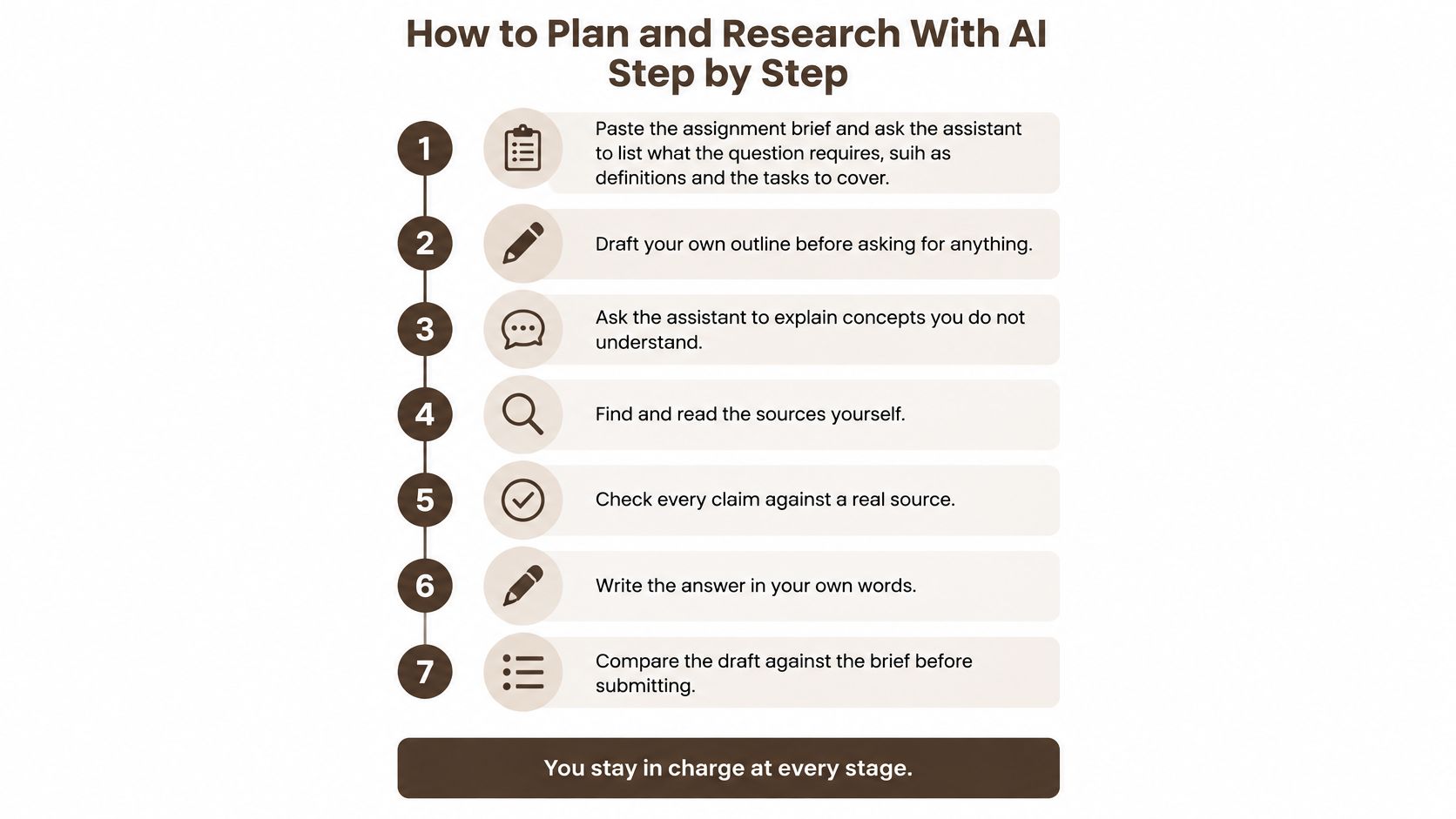
Build the argument before polishing it
Unpack the assignment brief. Where uploading is permitted, paste the brief and ask the assistant to identify the required definitions, evidence, judgments, and format, then compare its interpretation with the original. The common slip is trusting its paraphrase when it has missed an instruction such as “critically evaluate.”
Ask for three possible angles, then choose one and explain in your own words why it fits. This makes you justify the direction before committing to research, rather than accepting the first plausible topic the assistant offers.
Build an outline with evidence gaps. Give each section a purpose and an evidence need, such as explaining a mechanism or comparing outcomes, and mark what you haven't established. Don't mistake a neat sequence of headings for a supported argument.
Request search terms, relevant disciplines, and useful source types, then find and open the sources yourself. Search your library catalogue or subject database using those terms, because the common slip is treating a generated bibliography as completed reading.
Write your own source notes. Summarize each source's argument, evidence, and limitations, recording the relevant page or paragraph as you go. Avoid copying a summary into your notes without checking it, since you may later mistake the assistant's interpretation for the author's position.
Ask for the strongest counterargument to your position and write your response yourself. This tests whether your claim survives a serious objection, but don't accept an invented opposing view when the literature contains a more demanding one.
Draft from your notes, then request feedback. Keep sentence-writing with you and ask the assistant to identify structural gaps, unclear transitions, or unsupported conclusions. The common slip is accepting replacement paragraphs instead of deciding how to revise.
Make the plan usable
Assign separate time for reading, drafting, and checking. Pretty Progress's guide to keeping every course deadline visible can help you organize those commitments without confusing a submission date with a research schedule.
For a report-based assignment, our guide to generating a report offers another workflow to examine. Adapt any suggested structure to your assessment criteria rather than allowing a generic report format to determine your answer.
A finished plan should fit into a concise, one-page outline. Each proposed claim should point to a source you've read, while any remaining gap should be explicitly marked rather than filled with plausible text.
How to Verify Every Claim Before You Use It
AI can produce fluent text that is wrong. It may invent a citation, misread a figure, or present an unsupported interpretation as settled fact. A tool that searches, reads, and generates in sequence still needs someone to inspect the result.
In RE-Bench, leading AI systems scored four times higher than human experts with a two-hour time horizon, but human experts outscored AI systems by two to one when given 32 hours, according to the Stanford AI Index's benchmark reporting. That finding concerns a particular evaluation, not assignment grades, but it supports treating multi-step agents as assistance rather than proof of autonomous reliability.
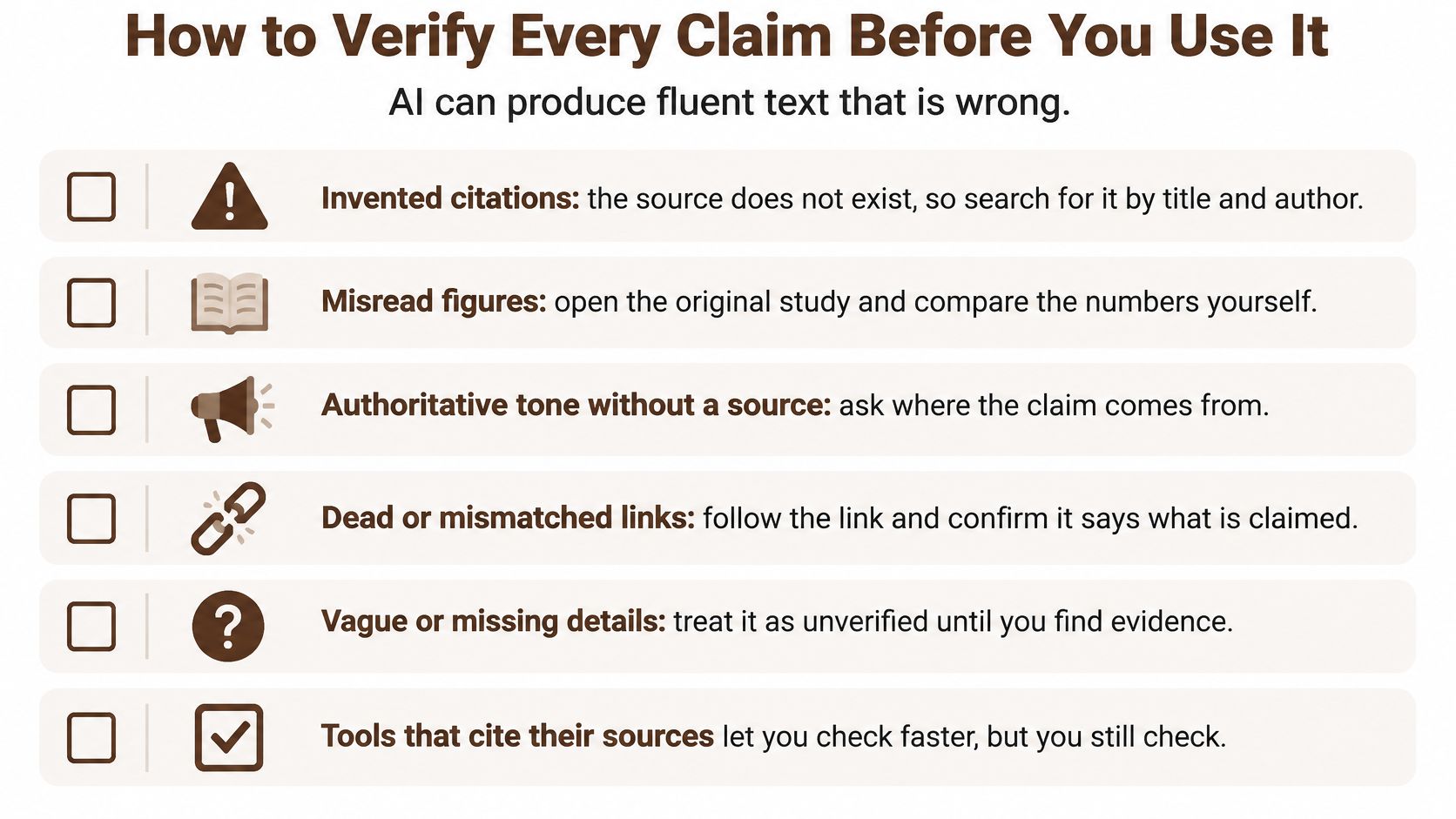
Use a claim-by-claim checklist
- Trace the claim. Find an original source you can open and identify the passage that supports it.
- Inspect the source. Check the publication date, author credentials, and whether peer review applies.
- Compare independent evidence. Consult at least two independent sources where possible, noting disagreements rather than hiding them.
- Recalculate quantitative results. Check the original values, units, denominator, and calculation yourself.
- Separate fact from inference. Mark which statements the source establishes and which interpretations the assistant has added.
- Confirm the reference exists. Search the title and author in a library database or on the publisher's site, then check that the reference matches the claim.
Why tracing and recalculating matter
Source tracing checks more than existence. A real paper might concern a different population, reach a narrower conclusion, or describe a correlation that the assistant has turned into a causal explanation. Read enough surrounding text to understand what the author is claiming.
Recalculating numbers catches another kind of distortion. For example, a summary might confuse a percentage change with a percentage-point difference or compare figures measured over different periods. Use a calculator or spreadsheet and retain the working alongside your notes.
Our AI fact-checking guide offers further ways to organize this review. Tools that expose supporting documents can shorten the search, but they don't decide whether the evidence justifies your sentence.
In history, law, and policy, disagreement may reflect different interpretations rather than a simple error. Describe the competing positions and explain your judgment instead of choosing whichever answer sounds most confident.
Your final test is practical: can you explain the claim accurately with the assistant closed?
Keeping Your Work Academically Honest
Using AI isn't automatically misconduct, and avoiding AI isn't the only way to demonstrate integrity. The important questions are whether the support is permitted and whether you accurately represent your authorship. These are separate questions, and you must satisfy both.
Uncertainty is understandable. In a 2025 survey of 1,041 UK undergraduates, 53% said fear of being accused of cheating discouraged AI use, according to the HEPI–Kortext Student Generative AI Survey. Your own assessment brief and institutional policy, rather than other students' habits, determine your next move.
Keep a disclosure record as part of the assignment
Disclosure record to keep for each assignment
| Record item | What to write | Why it matters |
|---|---|---|
| Tool used | Name and version of the AI tool | Shows what produced the help |
| Task requested | The exact question or request you made | Shows where help stopped and your work began |
| Output used | Which parts you kept, changed or discarded | Separates your authorship from generated text |
| Verification done | Sources you opened and figures you rechecked | Supports every claim you submit |
| Policy followed | The course or institution rule that applied | Shows you checked the requirements |
Create this record when you start, not after someone asks about your process. If a version isn't displayed, record that rather than guessing, and preserve relevant prompts or outputs when institutional guidance permits.
The record helps distinguish assistance from your contribution. It also prepares you for a viva, oral exam, or tutor meeting because you can explain how your ideas developed and why you accepted or rejected a suggestion.
Ask a precise policy question
When the rules are unclear, send an instructor a concrete question:
May I use an AI tool to summarize a supplied reading for private study if I read the original myself, and must I acknowledge that use in this assignment?
That's easier to answer than asking whether AI is allowed generally. Keep the response with your assignment materials and check whether it applies only to that task.
For citation, follow the institution's required style for AI tools. Acknowledge assistance where it informs the submitted work, while separately completing any broader declaration the course requires. Cite the original scholarly sources for evidence rather than treating an assistant's response as a replacement for them.
Asking for help isn't the problem. Hiding help or using prohibited assistance is. Documentation makes permitted use transparent, but it cannot turn an unauthorized task into an acceptable one.
Examples of Good and Poor Use in Real Assignments
The following students are illustrative composites, not real cases. Their situations show how a small decision during the process can change whether the finished work demonstrates learning.
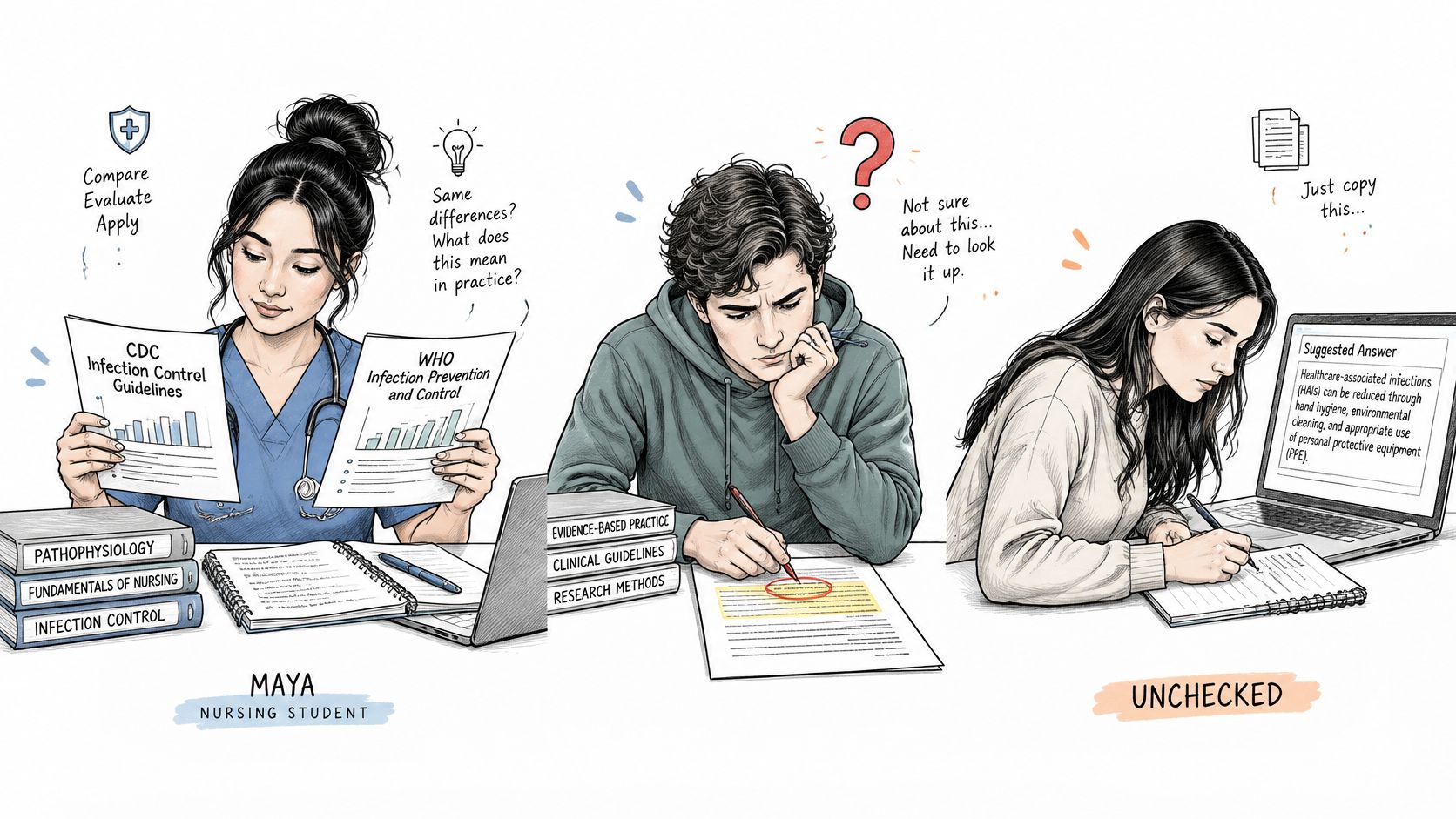
Maya uses an explanation to begin a comparison
Maya, a second-year nursing student, asks an assistant to explain the difference between two infection-control guidelines. Her course permits concept explanations, so she uses the response to identify points she needs to investigate, then reads both documents herself.
She writes her own comparison and checks each figure against the original text. Her disclosure record names the tool, preserves her question, and identifies the sections she verified.
In this scenario, her tutor praises her reasoning during the oral follow-up because she can explain why the guidelines differ. The decisive choice was returning to the documents before forming her judgment, rather than adopting the assistant's comparison.
Daniel treats editing as authorship
Daniel, a business student, pastes his brief into an assistant, receives a full essay, and submits it with light edits. His course prohibits generated submissions, so changing phrases doesn't resolve the breach.
When his tutor asks about a statistic, Daniel can't locate its source or explain how it supports the argument. He has neither reliable evidence nor a record of developing the reasoning himself.
The line was crossed when he adopted the generated essay as his submission. The missing citation exposes a further weakness, but even accurate references wouldn't make prohibited ghostwriting acceptable.
Priya uses questions to practise retrieval
Priya, a history student, asks for practice questions based on lecture notes she's permitted to upload. She closes the assistant, answers from memory, and then compares her answers with the notes.
When a question misrepresents an event, she corrects it instead of memorizing the mistake. She uses the exercise to identify a topic she needs to revisit before the exam.
Her decision point is answering independently before checking. Maya uses explanation to support analysis, Daniel substitutes generated work for his own, and Priya uses questions to test what she knows.
The assistant may test your understanding, but your understanding must be what produces the answer.
Choose Your Next Step for the Next Assignment
Choose a task that leaves you clearly responsible for the result. Planning an outline or requesting structural feedback on a draft you wrote is a sensible starting point when your course permits it. You don't need to test every available function on an assessed piece of work.
Before opening a tool, create the disclosure record and name the support type you intend to use. Set a boundary in the request, such as asking for questions about your structure rather than rewritten paragraphs.
Try a small, observable task
Use a short section you understand well enough to evaluate. If the assistant offers a factual claim, pause and verify it before allowing it to shape your draft. If it suggests a structural change, write down why you accept or reject that change.
A workspace such as BromeAI is one option for keeping readings, drafts, and research together, provided its privacy terms satisfy the provider checks for your task. Our Agentic AI shows a visible task list so you can see what Brome intends to do and what it has finished. Each finding in an answer points back to the document it came from, allowing you to inspect the supporting material.
Those features can make the process easier to examine. They don't establish whether your instructor permits the task or whether your interpretation is sound.
Make these decisions before you begin
- Check this course's rule. Read the syllabus and assessment brief, and ask the instructor about any unresolved restriction.
- Choose one permitted kind of help. Record its purpose before requesting output, and keep the question, argument, and final wording with you.
- Verify the first claim. Open its supporting source before writing it into your own work.
BromeAI offers document analysis and source-linked research assistance that you can use within your course's rules. Visit BromeAI to explore a workspace for checking readings and organizing permitted study support, with your disclosure record alongside your own work.