Project Proposal Writer: Use AI to Plan, Draft and Refine
In 2024, proposal professionals worked on an average of 7 RFPs per month, according to QorusDocs' benchmark survey of proposal teams. Seven live bids at once, each with its own rubric, page cap and evidence pack, is why so many submissions fail on details nobody scheduled time for. A missing signature. A metric with no source behind it. A budget total that disagrees with the narrative three pages later.
AI has changed the arithmetic of that workload. Extracting requirements used to eat an afternoon and now takes minutes. First drafts appear while the coffee is still hot, and consistency checks catch the mismatches a tired writer misses at 11pm. What hasn't changed is who owns the risk when a claim can't be verified or a form goes unsigned.
That split, machine speed for the mechanical work and human ownership of evidence and compliance, is what separates a proposal that scores well from one that gets scored at all.
Table of Contents
- What a Project Proposal Writer Delivers
- Build a Requirements Matrix Before Drafting
- Set Evidence Thresholds and Accessible Formats
- Draft Each Section and Protect Confidential Data
- Refine, Red-Team and Avoid Rejection
- Decide Whether to Submit and Start the Workflow
What a Project Proposal Writer Delivers
A proposal writer turns a project idea or solicitation into a submission an evaluator can score without guessing. The deliverable connects objectives to the buyer's stated outcomes, explains a method that can be assessed, lays out a timeline and its dependencies, reconciles the budget with the price schedule, identifies qualified people, and addresses risks directly. Prose carries the case; evidence and fit make it credible.
A strong proposal also makes the decision to bid clearer. It surfaces requirements the team cannot meet, claims that lack proof, and criteria where the project is a poor fit. That can save more effort than polishing a draft for a bid the organization should not submit.
What changed by 2026
AI can speed up requirement extraction, first drafts and consistency checks. The writer still has to judge whether a claim is supported, whether a past project fits the criterion, and whether the response answers the requirement rather than merely mentioning it.
The work serves more than agency bid teams. Freelance bid writers, researchers responding to grant calls, small firms pursuing public tenders, and students planning your dissertation research proposal all need to match a submission to its audience and evaluation criteria. The formats and standards differ, but clarity, evidence and a complete response matter in each.
Build a Requirements Matrix Before Drafting
Procurement rules make this essential. Evaluators may apply only the criteria disclosed in the solicitation, so extra content earns nothing while a missing item can end the bid. The World Bank's procurement guidelines put submissions through a preliminary examination first, where incomplete or invalid bids can be rejected before anyone reaches detailed evaluation. Your prose never gets read if the envelope is wrong.
Five steps, in this order.
- Load the whole solicitation. The RFP, tender or grant call plus every annex and the price schedule, then ask for a numbered inventory of requirements, eligibility rules and evaluation criteria. Disqualifiers hide in annexes and in the instructions to bidders, not in the scope section.
- Classify each line. Pass or fail gate, scored criterion, or background. Gates come first because they kill a bid outright, and scored criteria take drafting time in proportion to their points.
- Assign every requirement a home. Section, evidence source, owner, status. The table below is the shape I use, and the status column is the point of it. It tells you what's done and what's wishful.
- Copy the published weights verbatim. Then rank drafting effort by points rather than by which section is more interesting to write. A 30 point technical approach deserves three times the effort of a 10 point sustainability annex.
- Compress the matrix into a one-page evaluator map. Criterion on the left, the page and paragraph that answers it on the right. This page never ships. It's how you check the draft before a reviewer does.
| Requirement | Proposal section | Evidence needed | Owner | Status |
|---|---|---|---|---|
| Technical approach covers every scope task | Solution and methodology | Work packages mapped to each SOW task | Solution lead | Drafted |
| Relevant past performance | Experience and references | Two comparable projects with outcomes and client contacts | Delivery manager | Evidence requested |
| Key personnel qualifications | Team and staffing | CVs, certifications and availability letters | Resource manager | In review |
| Feasible schedule | Timeline and milestones | Milestone table with dependencies and critical path | Project manager | Drafted |
| Quality control arrangements | Quality assurance | QA process, review gates and acceptance metrics | QA lead | Gap flagged |
| Price within the budget ceiling | Cost proposal | Itemized budget matching the bill of quantities | Finance lead | Pending |
| Eligibility and signed forms | Annexes | Signed declarations, registrations and disclosures | Proposal manager | Not started |
Government of Canada procurement guidance recommends criteria proportionate to a project's complexity, risk, value and objectives, quantifiable wherever practicable, and it treats traceability as the benchmark. Every major claim linked to a requirement, an evidence source, a measurable output, a responsible person, a milestone and an acceptance test. That is a matrix, described from the buyer's side of the table.
Practical rule: if a criterion has no row in your matrix, it has no answer in your draft, and an evaluator scores it as missing rather than inferring it from your enthusiasm.
If eligibility itself is murky, check eligibility before bidding federal contracts before you sink a day into a matrix you can't submit.
Set Evidence Thresholds and Accessible Formats
Two decisions belong before the first prompt. How much proof each claim needs, and what the solicitation demands on accessibility. Both are cheap now and expensive later.
Set the evidence floor first
Give every problem claim a dated source from the solicitation, the client's own documents or your discovery notes. If you can't point at one, the sentence gets a VERIFY tag instead of an invented statistic. That tag is a to-do list, not a style note, and it should be empty before submission.
Then set thresholds by claim type.
- Capability claims: a named project, a metric that moved, and a reference who will confirm both on a phone call.
- Outcome claims: a baseline, an indicator, a target and an acceptance test. "Improved reporting" is not a claim, it's a mood.
- Method claims: the sequence of work, who does it, and what the client receives at the end of each phase.
- Risk claims: a specific mitigation with an owner and a trigger point, not a promise to monitor closely.
Make accessibility a scored item
Recent Canadian procurement guidance states that solicitation documents should use plain language and be available in accessible formats, and that accessibility requirements should be integrated across planning, bidding, award, contract management, specifications and evaluation, as set out in Accessibility Standards Canada's procurement guidance. That's a compliance requirement wearing a formatting costume.
The procedure I follow:
- Find the standard the solicitation names. Markets differ, and citing the wrong one signals you didn't read the document closely.
- Describe outcomes measurably. Percentage of documents delivered as tagged PDF or accessible DOCX, alt text on every figure, heading structure preserved in the export.
- Write plainly. Page limits are not targets. If an evaluator has to read your scope section twice, you've lost points to style that should have gone to evidence.
- Export from the source file. Printing to PDF from another tool usually flattens reading order. Export from the document, then run an accessibility checker before upload.
- Add the accessibility plan as a matrix row. If it's in the matrix, an evaluator can find it, and so can you at 2am.
Keep every section scannable. Headings that mirror the rubric let a reviewer locate each scored answer in seconds, which is exactly what a tired evaluator does.
Draft Each Section and Protect Confidential Data
Draft in a loop, not in one sitting
Load the project brief, the matrix and the evaluation weights once, at the start of the session, so every prompt inherits them. Then work body sections before the executive summary. A summary written first is fiction until the numbers exist, and a summary written last quotes real ones.
- One section per prompt, with its matrix row attached. The row carries the criterion, the evidence source and the owner. The prompt stops being "write about our quality process" and becomes "answer this criterion, using this evidence, in 400 words".
- Require structure inside every technical claim. Baseline, measurable target, method, milestone, risk response. If the model can't fill five slots, the claim isn't ready to ship.
- Replace placeholders with real evidence. Named projects, verified figures, actual CVs. Anything unconfirmed carries a VERIFY tag that survives to the final read.
- Cut boilerplate. Reused past-performance paragraphs should be rewritten for this solicitation, using this scope, this client's vocabulary and these criteria.
- Keep the audit trail. Prompts, source files and versions in one workspace so the reasoning survives staff changes and a reviewer can see where a number came from.
| Proposal section | Prompt to give the AI | Human check before accepting |
|---|---|---|
| Executive summary | Draft a one-page summary using only figures from the finished body sections and the price schedule | Every number matches the body sections |
| Problem statement | Restate the requirement and client pain using only facts from the RFP and our discovery notes | No invented statistics or causes |
| Methodology | Draft the technical approach as phased work packages with deliverables per phase | Each phase maps to a scored criterion |
| Timeline | Build a 9-month milestone table with dependencies and a critical path | Dates align with the staffing plan |
| Budget narrative | Explain the cost lines from the attached spreadsheet in plain language | Figures match the price schedule exactly |
| Team section | Turn the attached CVs into role paragraphs tied to the evaluation criteria | Claims are supported by the actual CVs |
| Risk register | List the top 8 delivery risks with likelihood, impact, mitigation and owner | Mitigations are specific actions, not promises |
When the draft has to become a formatted deliverable for an internal reviewer, generating a report from your source documents keeps the evidence attached rather than restating it from memory.
Protect the confidential material
Bid documents carry client names, pricing, org charts and sometimes personal data. Three checks before you paste anything.
- Strip identifiers when tool policy is unclear. Client names, contract values and staff details become Client A, Program B and Team lead.
- Confirm the training and retention position in writing. Conversations and files excluded from model training is one control. Zero retention agreements with model providers is another. Neither alone is a full privacy answer.
- Confirm deletion works. Under GDPR Article 17, individuals can request erasure without undue delay in specified circumstances, as set out in the text of Article 17, and the right isn't absolute: legal obligations, public-interest tasks, archiving or research, and the establishment of legal claims all create exceptions. A tool that promises unconditional erasure is describing something the law doesn't.
The European Commission's data protection by design principle pushes this further upstream. Safeguards belong in the routing, file handling, storage, access and deletion design, not in a policy page bolted on afterwards. For European tenders, ask about EU hosting alongside retention terms, because transfer arrangements are part of the same decision.
A first draft that once took a week of blank-page work can now come together in a day. Spend the difference on evidence and review rather than on more drafting.
Refine, Red-Team and Avoid Rejection
A proposal can meet every formal requirement and still score poorly if its strongest claims are difficult to compare. The World Bank's value for money guidance says evaluation criteria should be applied consistently and that decisions can weigh price alongside technical, quality and other non-price factors. Write so each criterion has clear, verifiable evidence beside it.
Score the draft the way a reviewer will
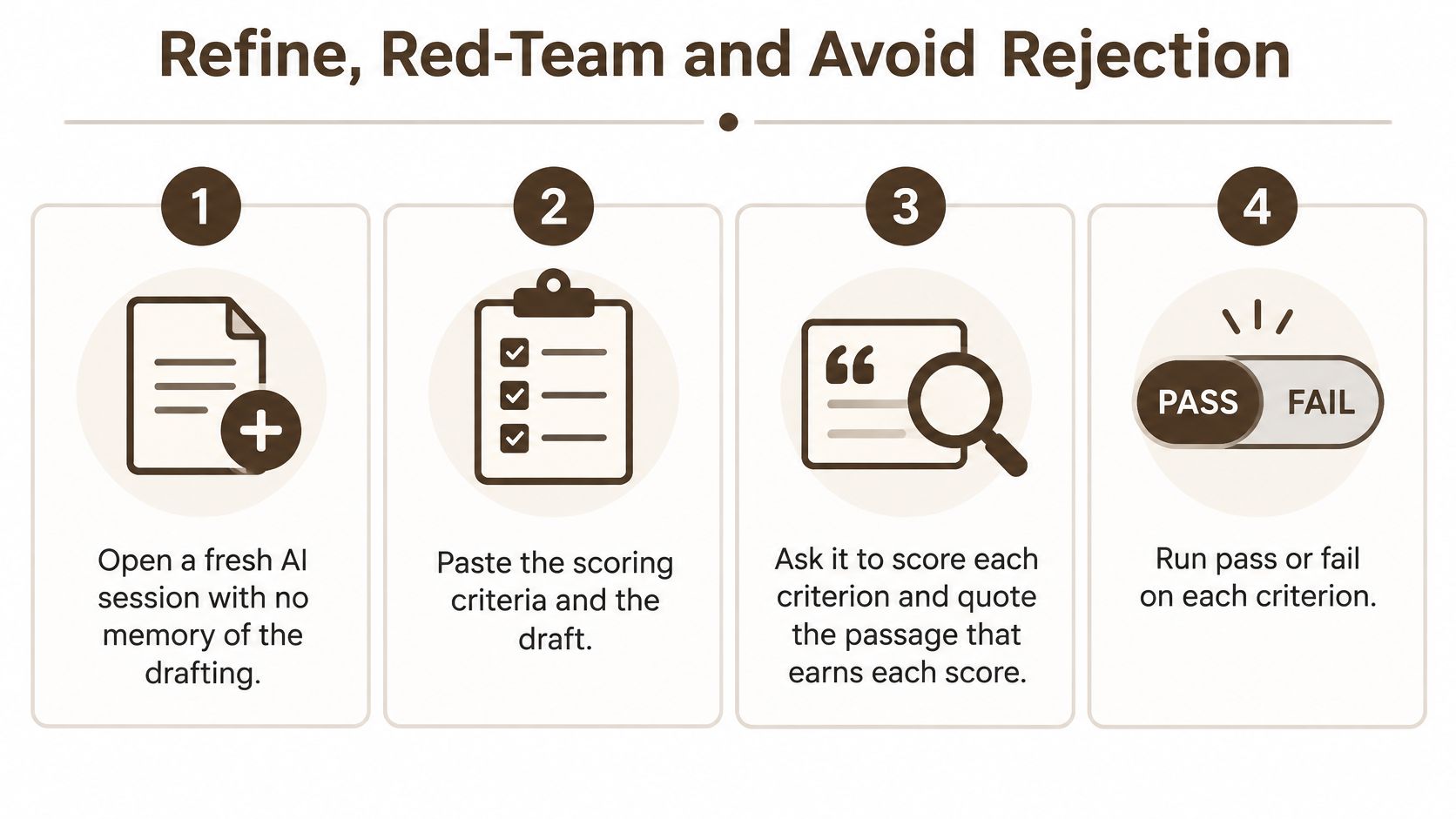
Start a fresh review session without drafting context. Provide the scoring criteria and full draft, then request a score for each criterion and the exact passage supporting it. Check every quotation against the draft. If the model cites text that is not there, its score is not reliable.
Check pass-or-fail requirements separately. Confirm signatures, forms, eligibility evidence, page limits, file format and naming conventions against the solicitation. Then ask for the three weakest arguments and every claim that lacks proof. AI can identify likely gaps quickly; a human still needs to judge whether the evidence is relevant and persuasive.
A criterion without evidence is a defect, not an invitation for the evaluator to fill in the gap.
Reconcile the three documents that have to agree
Review the narrative, budget and timeline side by side. Figures and dates should trace to a single source of truth, such as the approved price schedule. If the narrative places phase two in month four while the Gantt chart places it in month five, resolve the conflict before submission.
Replace praise with evidence an evaluator can assess. “World-class delivery team” says little about capability. “12 named specialists, 4 certified in the required platform, average 6 years on comparable programmes” gives the reviewer details to assess, provided each detail is documented.
Run the audit 48 hours out
A grant-writing guide from the Medical University of South Carolina research office reports average proposal success rates of roughly 20 to 30% across examples including NSF, NIH, USDA and private foundations. It also states that about 60% are rejected at first reading because the proposal does not match the program or the applicant failed to follow directions. These figures are not universal benchmarks. Use them as a reminder to check fit and instructions, not as a forecast of your odds.
| Symptom | Likely cause | Fix |
|---|---|---|
| Rejected at compliance screening | Missing signature, form or eligibility document | Check every pass-or-fail requirement 48 hours before the deadline |
| Low technical score | Generic boilerplate not mapped to scoring criteria | Rewrite each section against its matrix row and the quoted criterion |
| Evaluators doubt capabilities | Claims lack supporting evidence | Pair each claim with documented projects, metrics or references |
| Scope mismatch | Proposal answers a different problem than the RFP | Compare the problem statement with the RFP scope sentence by sentence |
| Budget flagged | Figures differ between narrative, spreadsheet and summary | Reconcile all three against one source of truth |
| Activities without outcomes | No measurable indicators or verification method | Add a baseline, target, indicator and acceptance test for each activity |
| Innovation dismissed | No comparison with the current state of the art | Add a sourced benchmark paragraph |
Prioritize fixes by effort and consequence. Reconcile inconsistent figures while the source documents are open; request references early if they will take time to collect. AI can support reconciliation and pattern-spotting, which is one example of where AI helps grant writers. A person still needs to secure references and confirm that evidence supports the claims being made.
Before submission, check every number, name and date against its source. An AI fact-checking workflow can help flag claims for review, but the writer must confirm the underlying evidence, especially in cost tables.
Decide Whether to Submit and Start the Workflow
The most valuable output of an AI-assisted process is sometimes a decision not to bid.
Start with eligibility and program fit. If the call excludes your organization type, your geography or your stage of development, nothing downstream matters. Then score the survivors on six things.
- Need: who is worse off without this, and is there a document that says so.
- Novelty: what already exists, and why it fails in this specific setting.
- Feasibility: can this be delivered in the window with the people you have.
- Team capability: named people, relevant work, hours available.
- Measurable outcomes: indicators you can defend at review, not activity counts.
- Budget realism: does the price cover the work, and does it fit the buyer's ceiling.
The NonProfit PRO analysis of common grant proposal mistakes makes the same point from the losing side. Broad, poorly targeted applications waste limited staff time, and generic answers are a recognized error rather than a neutral habit. Declining a weak fit, or narrowing the project until it fits, is often the highest-return editorial decision available.
I would also resist quoting win rates as encouragement. Base rates differ enormously by scheme and methodology, and a responsible writer communicates uncertainty instead of implying that better wording guarantees funding.
Where the workflow runs
Run the matrix, the drafting loop and the red-team pass in one place rather than across four browser tabs. In BromeAI, agentic workflows show the bid as a visible task list before anything runs, so you can see what the system intends to do and what it has finished, and it reports back with sources once every task is done. Document processing reads PDFs, images and files together, which matters when the RFP, the budget spreadsheet and the CVs have to be analyzed in the same breath, and model routing picks a suitable model per task while you keep the final call. The AI workspace is only as good as the evidence you feed it.
Pick one live RFP this week. Build its requirements matrix before you write a single sentence of prose.
BromeAI keeps the whole sequence in one workspace: upload the solicitation, the budget spreadsheet and the CVs, watch the agentic workflow lay out its tasks before anything runs, and get a sourced report back when it's finished. You keep the judgment calls, the go or no-go decision and the evidence standards, which is where bids are won. Start with one live tender at BromeAI and have its requirements matrix built before the week is out.