Mixture of Agents: How AI Models Work Together
A mixture of agents uses several AI models or agents on one task, then combines their outputs into a single result. If three models agree on an answer, does that agreement make the answer more trustworthy, or could it mean all three share the same blind spot?
That question matters because adding agents is easy to describe and harder to justify. Each extra model adds tokens, latency and another place where an error can enter. A mixture earns that cost only when each member contributes something distinct and a final stage can tell good work from confident noise. Treat the design as a hypothesis you test against one strong model, not as an automatic upgrade.
Table of Contents
- What a Mixture of Agents Means and Where It Came From
- How Agents Pass Work Up Through Layers
- Matching the Right Architecture to Your Task
- Worked Examples From Research and Document Work
- Where Mixtures Fail and How to Contain Errors
- Privacy and Governance at Each Handoff
- Confirm a Mixture Fits Before You Build One
What a Mixture of Agents Means and Where It Came From
A mixture of agents is a setup in which several AI models or agents each handle part of a task, and a final step combines their outputs into one result. Picture a small film crew working on one scene. A researcher finds sources, a writer drafts the script, and an editor checks the draft and decides what reaches the final cut. No single person does every job, and the editor can reject work that doesn't hold up.
That crew has three parts you'll find in every mixture. There are specialized members that do the work, a way to send work to them, and a way to combine what comes back. If any part is missing, you don't have a mixture. You have several disconnected chats.
Two Ideas Hide Under One Term
The term covers two related designs. In an inference time ensemble, several language models answer the same question independently, then another model merges their answers into one response. In a routed design, the system picks the right model for each request, so a question about figures goes to one model and a question about wording goes to another. Both designs divide work, but the first runs members in parallel on the same input while the second sends each input to a chosen member.
A single chatbot calling a calculator or a search tool isn't a mixture, because only one reasoning component is doing the thinking.
Readers often trip over that distinction. A tool returns data, but an agent interprets, drafts or judges. A mixture needs several of those reasoning components, plus the combining step. If you're mapping your own setup inside an AI workspace, count the components that reason about the task, not the tools they call.
An Old Principle With New Parts
The modern idea traces back to the 1991 paper Adaptive Mixtures of Local Experts, which paired specialized neural networks with a learned gating network that assigned each case to the expert best suited to it, and IBM's overview of mixture of experts reports that this experimental mixture reached its target accuracy in half as many training epochs as a comparable conventional model. Think of a help desk where each ticket goes to the specialist for that issue instead of to one generalist who handles everything. The gating network played the role of the person sorting tickets at the front desk.
Later work pushed the same principle toward sparse routing, where only a small number of experts activate for each input, which cuts the computation needed per example. The components have changed completely since 1991, since today's members are full language models rather than small networks. The principle hasn't changed at all. Divide the work, route each part to a suitable specialist, and combine the results.
Before going further, try one small exercise. List the members of a workflow you already use, even if it's just you pasting text between two chat windows. Ask whether each member has a distinct job you could describe in one sentence. If two members do the same job in the same way, one of them is probably adding cost without adding judgment.
How Agents Pass Work Up Through Layers
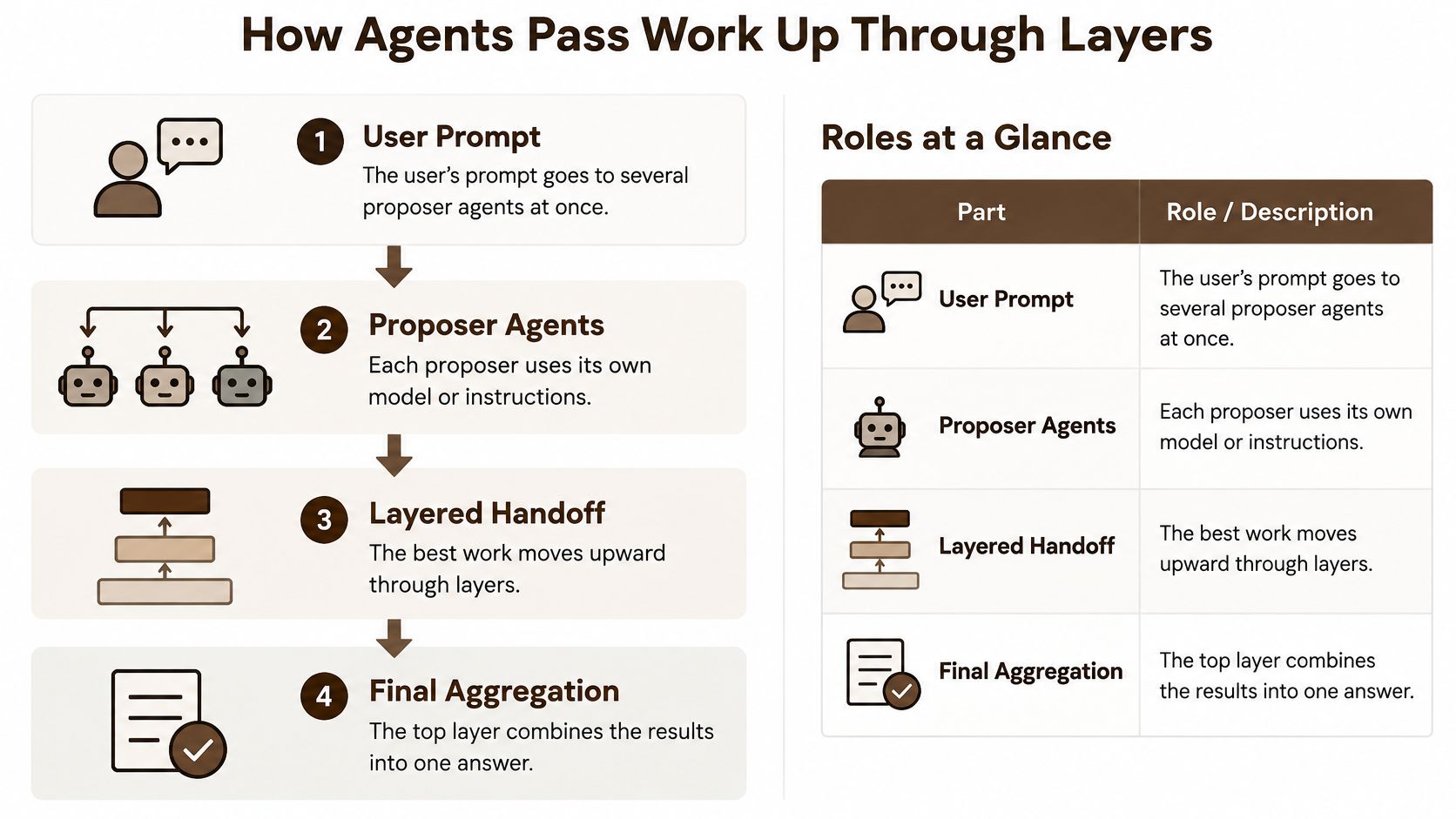
Work in a mixture moves upward through defined stages, and each stage exists for a reason. The diagram below shows the flow from prompt to final answer. Read it top to bottom, then walk through each stage with the table that follows.
The Five Stages in Order
- The prompt fans out. Your prompt goes to several proposer agents at once, each using its own model or its own instructions. Running them in parallel keeps the slowest proposer, rather than the sum of all proposers, as your waiting time.
- Each proposer answers alone. Every proposer returns a candidate answer and keeps its reasoning or sources attached. Independence is the point here, because proposers that read each other's drafts early tend to converge on the first plausible answer.
- The aggregator synthesizes. An aggregator receives every candidate and writes one response, weighing drafts by how well they're supported rather than counting votes. The common slip is an aggregator that copies the most confident sounding draft, which wastes the whole panel.
- Optional layers refine. A further layer can read the synthesized draft and improve it, much like a second editor. The risk is that each new layer repeats an error from the layer below with fresh confidence, so refinement only helps when agents check against sources instead of against each other.
- A checker guards release. A critic or checker tests the final answer against sources or rules before anyone acts on it. Without this stage, fluent mistakes pass through with the panel's authority behind them.
| Role | Main Job | Passes On |
|---|---|---|
| Proposer | Draft an answer or analysis from its own angle | One candidate response with supporting notes |
| Aggregator | Combine candidates into one answer | A single synthesized draft |
| Critic or checker | Test claims against sources or rules | Accept, reject or request revision |
| Router | Choose which model or agent handles each request | A routing decision for each sub-task |
What Each Extra Layer Costs
Every layer you add costs tokens and time. The aggregator must read every proposer output, so its input grows with each member you add. A second refinement layer reads all of that again and generates another full draft. You're paying for several complete answers to produce one, which is reasonable for a hard question and wasteful for a simple one.
Practical rule: If you can't name what each agent contributed and show where the final answer came from, the mixture is a black box with extra steps.
Run that test on any system you meet. Ask which agent produced a specific claim in the final answer. If nobody can trace it, the layering is hiding problems instead of solving them.
Matching the Right Architecture to Your Task
Start with one test question. Does your task split into independent parts, or does it form a chain where each step depends on the last one? That single distinction decides most architecture choices. Independent parts reward parallel agents, while chained steps punish them.
| Task Structure | Architecture That Fits | Why It Fits | Main Risk |
|---|---|---|---|
| Independent sources to review in parallel | Several proposers feeding one aggregator | Each agent reads different material and the aggregator merges findings | Correlated errors when agents share a blind spot |
| Dependent steps where each needs the last | Single agent or orchestrator with ordered handoffs | Later steps need the verified output of earlier ones | Parallel agents multiply one early mistake |
| High-stakes single answer, such as a contract clause | Strongest model sampled several times with a checker | Diversity adds noise when one model is clearly stronger | Consensus can reinforce one wrong reading |
| Tasks needing different tools or knowledge | Routed mixture of specialized models | The router sends each sub-task to the model suited to it | Routing errors send work to the wrong model |
| Creative drafting with many valid answers | Layered proposers with an aggregator that blends drafts | Varied styles add useful range to the final draft | The aggregator can flatten distinct voices |
Reading the Table Row by Row
When sources are independent, several proposers feeding one aggregator work well because each agent reads different material and disagreement carries information. When steps depend on each other, a single agent or an orchestrator with ordered handoffs fits better, since a later step should build on verified output rather than on a guess made in parallel. For a high stakes single answer, sampling the strongest model several times and adding a checker often beats mixing in weaker models that mostly add noise.
Routed mixtures suit tasks that need different tools or knowledge, which is the logic behind automatic model routing that sends each question to a suitable model. Creative drafting is the forgiving case, because many answers are valid and varied drafts give the aggregator useful range. If you want a deeper treatment of how these patterns scale in production systems, the guide to designing scalable multi-agent architectures from Cyndra walks through orchestration choices in engineering detail.
Evidence That Variety Is Not Automatically Better
Benchmark results cut both ways, which is why testing matters. In the original Mixture-of-Agents benchmark study, a layered mixture reached a 65.8% win rate on AlpacaEval 2.0, compared with 57.5% for the previous best system, GPT-4 Omni. Yet a NeurIPS study on Self-MoA found that aggregating several responses from one top performing model outperformed standard MoA, which mixes different LLMs, by 6.6% on AlpacaEval 2.0 and by an average of 3.8% across MMLU, CRUX and MATH.
So treat model variety as a hypothesis to validate, not a benefit you get for free. Run the same task with a diverse mixture and with repeated samples from your strongest model, using the same token and cost budget for both. Compare accuracy and look at how the candidates disagree, because useful disagreement looks different from random variation.
One last design point. Have your aggregator weight candidates by evidence rather than by majority vote. Three agents can share one wrong assumption, and a vote turns that shared error into a confident final answer.
Worked Examples From Research and Document Work
Abstract designs get clearer when you watch specific jobs move through them. Each scenario below names the members, the handoff and the output you can verify. Notice that every example includes one failure and the fix that contained it.
Contract Review With Three Named Roles
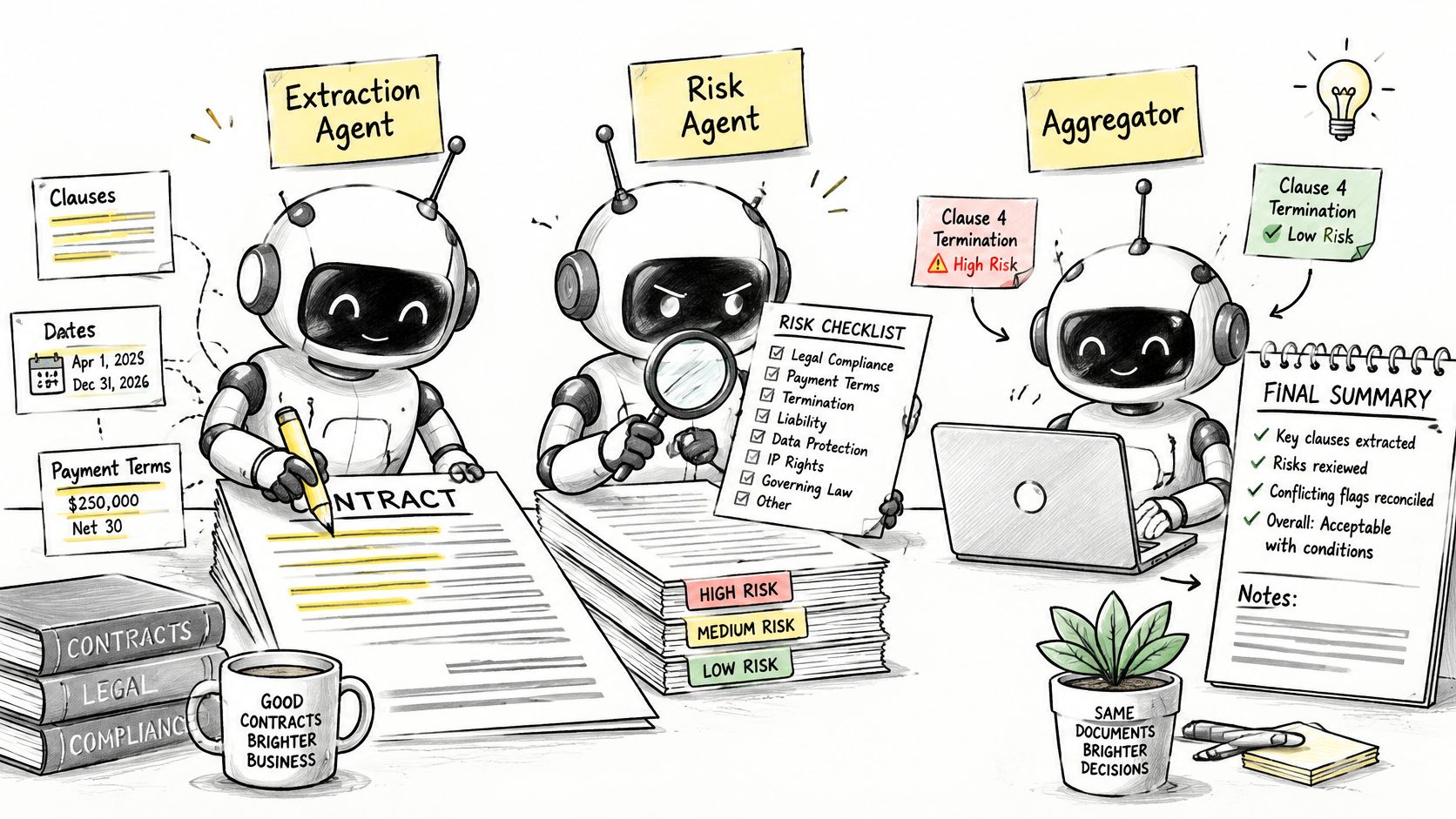
Say a legal team reviews a supplier contract before signing. An extraction agent pulls clauses, dates and payment terms into a structured list. A risk agent checks each clause against a checklist covering liability, termination and renewal terms. An aggregator reconciles conflicting flags and writes a summary that cites clause numbers, so a lawyer can verify every claim in minutes.
The failure shows up when two agents flag the same clause for the same wrong reason, perhaps misreading a standard limitation as unusual. Their agreement looks like strong evidence in the summary. The fix is to require every agent to quote the source text it relied on, which turns a suspicious consensus into something a reader can check line by line. This kind of clause level checking is where structured document analysis across the full file earns its keep.
A Research Brief Built From Sources
Now say a researcher needs a short brief on a contested topic. A retrieval agent gathers sources and records where each one came from. A reader agent summarizes each source separately and attaches citations to every summary. A synthesis agent drafts the brief from those summaries and marks claims with weak support instead of smoothing them over.
The verifiable output is a brief where each paragraph traces back to named sources. When two sources conflict, the synthesis agent reports the conflict rather than picking a winner on its own. That habit matters more than elegant prose, because the reader can weigh the evidence directly.
Invoice Checking and a Headline Set
For invoice and spreadsheet work, a router sends figure heavy questions to a model suited to tables and sends wording questions to a writing model. The failure here is a misrouted question that receives a fluent but wrong answer about numbers. The fix is to log every routing decision, so you can spot which questions keep landing with the wrong model and adjust the rules.
A fluent answer from the wrong model is more dangerous than a clumsy answer from the right one, because nobody thinks to double check it.
The lightest example is a headline set for an article or campaign. Several proposers draft options in different styles, and the aggregator blends the strongest parts into a shortlist. Quality is easy for a human to judge here, and a mediocre blend costs nothing but a few seconds. That low downside makes creative shortlists a safe place to learn how aggregation behaves before you trust it with contracts. Whatever the task, run the result through the checklist in the final section before you act on it.
Where Mixtures Fail and How to Contain Errors
The most common failure is correlated error. Agents built on similar training data often share the same misconceptions, so they agree on a wrong answer and that agreement looks exactly like confidence. A panel does not protect you when every member learned the same wrong lesson. Adding a second agent feels like adding a second opinion. Often it adds a second copy of the first mistake.
Four More Ways Mixtures Break
- Error amplification. Independent agents working without cross checking let one early mistake spread into every branch. In Google Research's study of 180 agent configurations, independent agents amplified errors by up to 17.2 times, compared with 4.4 times in centralized systems with an orchestrator.
- Sequential work split in parallel. When each step needs the previous result, parallel agents build on unverified guesses and the final answer degrades.
- Cost and latency stacking. Every added layer reads and rewrites the work below it, so slow and expensive answers arrive with no quality gain on easy tasks.
- Routing mistakes. A router that misclassifies a request sends it to the wrong model, and the answer comes back fluent, confident and wrong.
The broader lesson from that work is that architecture choice can be learned from task structure rather than guessed. Coordination helped parallelizable tasks and hurt sequential ones. Treat each added agent as a hypothesis to test against a simpler baseline, not as an automatic upgrade. Task structure, not agent count, drives the result.
Controls That Contain the Damage
Pair each failure with a control. Cap the number of layers so refinement cannot echo forever. Require each agent to quote its sources and record which agent produced each claim. Give one checker real authority to reject output, and set human approval for legal, financial or medical results. For a detailed look at catching problems as work moves between agents, the guide to monitoring multi-agent AI handoffs from IamVera.AI covers error cascades at each transfer point.
These controls match established risk practice. The U.S. National Institute of Standards and Technology released its Generative AI Profile on July 26, 2024 as a companion to the AI Risk Management Framework, with a trustworthiness scope covering validity and reliability, accountability and transparency, and explainability among other categories. Treat your mixture as a governed system under that lens, not as a chat window. And watch for the early warning sign. If two agents agree but cite no shared source, treat that agreement as unverified until someone checks it.
Privacy and Governance at Each Handoff
A provider promise that your files won't train a model covers one relationship with one vendor. A mixture multiplies the relationships. When a planner hands the same document to two researchers, then to a writer, then to a checker, that document exists as a separate copy in each context, under different retention terms and different access rules. Handoffs behave like a chain of custody for evidence: each transfer creates a record someone must sign, and the case is only as strong as the least careful signature.
The question at each step is therefore concrete. Where is this copy stored, who at that provider can read it, how long does it persist, and what triggers deletion? An operations lead can usually answer for the vendor the company chose deliberately, and cannot answer for the ones routing reached on its behalf.
What Governance Frameworks Actually Ask For
The NIST Generative AI Profile treats governance as a function that spans the system rather than a sign-off at the end. Under the AI Risk Management Framework core functions, the Measure function asks that AI models and systems be explained, validated and documented, with outputs interpreted in context. For a mixture that means a log naming which agent handled each request, what it received and how its output was assessed, including the routing decision that sent it there.
If you can't produce a record of which model saw a document, you can't prove how that document was handled.
Weak observability shows up repeatedly in practice. A survey of the agentic AI literature identifies reliability deficits, governance gaps and weak observability or safe termination as core weaknesses of agentic systems. Translate that into choices made before the first run: who can revoke a tool permission mid-task, what halts a layer that keeps refining, and where the run record lives afterwards.
Deletion Rights When Several Providers Are Involved
Erasure adds a legal layer on top of the operational one. Under EU GDPR guidance on data protection, the right to erasure is conditional rather than absolute. Organisations may refuse deletion when retention is necessary for a legal obligation, public interest, research, archiving or legal claims, and generally must respond no later than one month after the request. A deletion button in an interface starts that process. It does not finish it.
Downstream copies are where mixtures strain. The European Data Protection Board FAQ explains that when data covered by an erasure request has been transferred to other organisations, the controller must inform those recipients unless doing so is impossible or would require disproportionate effort. One conversation that moves through automatic routing or a manual model switch can reach several providers, so the recipient list grows with every layer you add.
Here the hypothesis test becomes a governance test. Each extra agent buys a chance at better output and costs one more recipient to name, one more retention policy to check and one more party to notify. Write down every provider that can receive a request, and how each would learn about a deletion. If that list has blanks, the architecture is not ready for the data you plan to put through it.
Confirm a Mixture Fits Before You Build One
Does the mixture earn its extra cost on your work? You can answer that with one honest comparison rather than a large experiment. Run these six steps in order and let the result overrule your assumptions.
- Write the task in one sentence. Mark whether its subtasks are independent or chained. Independent subtasks can run in parallel, and a second model can catch a gap. Chained subtasks pass output from one agent to the next, so an early mistake can travel upward with added confidence.
- Name each agent's contribution. If you cannot say what a member adds, drop it and use one strong model instead.
- Set a budget before you start. Fix the tokens, latency and cost you are willing to spend per answer, so the mixture cannot win by spending more.
- Run both designs on real examples. Test the mixture and a single model baseline on about 20 examples from your own work with the same budget.
- Compare accuracy and verify citations. Check every citation against its source. If several agents agree on the same wrong citation, agreement is not evidence.
- Assign a human reviewer. Any output with legal, financial or medical consequences needs a named person who approves it before use.
Step four is where many comparisons go wrong. A mixture can look better because it consumes more tokens or more retries. Hold the budget constant, then compare it against your strongest single model on the same examples. At step five, record whether the mixture caught errors the single model missed or repeated them. That record tells you whether you are adding independent judgment or amplifying one model's mistake.
Put the comparison into practice this week. BromeAI brings ChatGPT, Claude, Gemini, Mistral and other models into one European platform, so you can run the same task through several models in a single workspace and switch models without losing your conversation. Choose one real task from your current work and find out whether a mixture of agents beats your strongest single model. If it does not, a single strong model is the better architecture.