AI Fact Checking: How It Works and How to Verify Claims
ChatGPT correctly classified 90% of the false headlines in a 2024 PNAS study, identifying 18 of 20 as false and mislabeling none of them as true. On true headlines the same model produced a correct verdict only 15% of the time, 3 of 20, and was uncertain about 13. Full Fact's account of that study also found that handing people the model's assessment did not clearly improve their judgment, and in some conditions it reduced discernment.
That split is the right frame for AI fact checking. Strong detection of obvious falsehoods is not balanced accuracy, and a confident label is not a finished check. Each stage below can fail on its own. The useful habit is to ask which evidence the verdict rests on, then test that evidence yourself.
Table of Contents
- How AI Fact-Checking Works Stage by Stage
- How Accurate AI Fact-Checkers Really Are
- Where Retrieved Evidence Misleads the Model
- Which Sources Count as Reliable
- Sorting Out Conflicting and Changing Evidence
- How to Verify an AI Claim Step by Step
- Checking Documents and Sensitive Files
- Confirm Each Claim Before You Share It
How AI Fact-Checking Works Stage by Stage
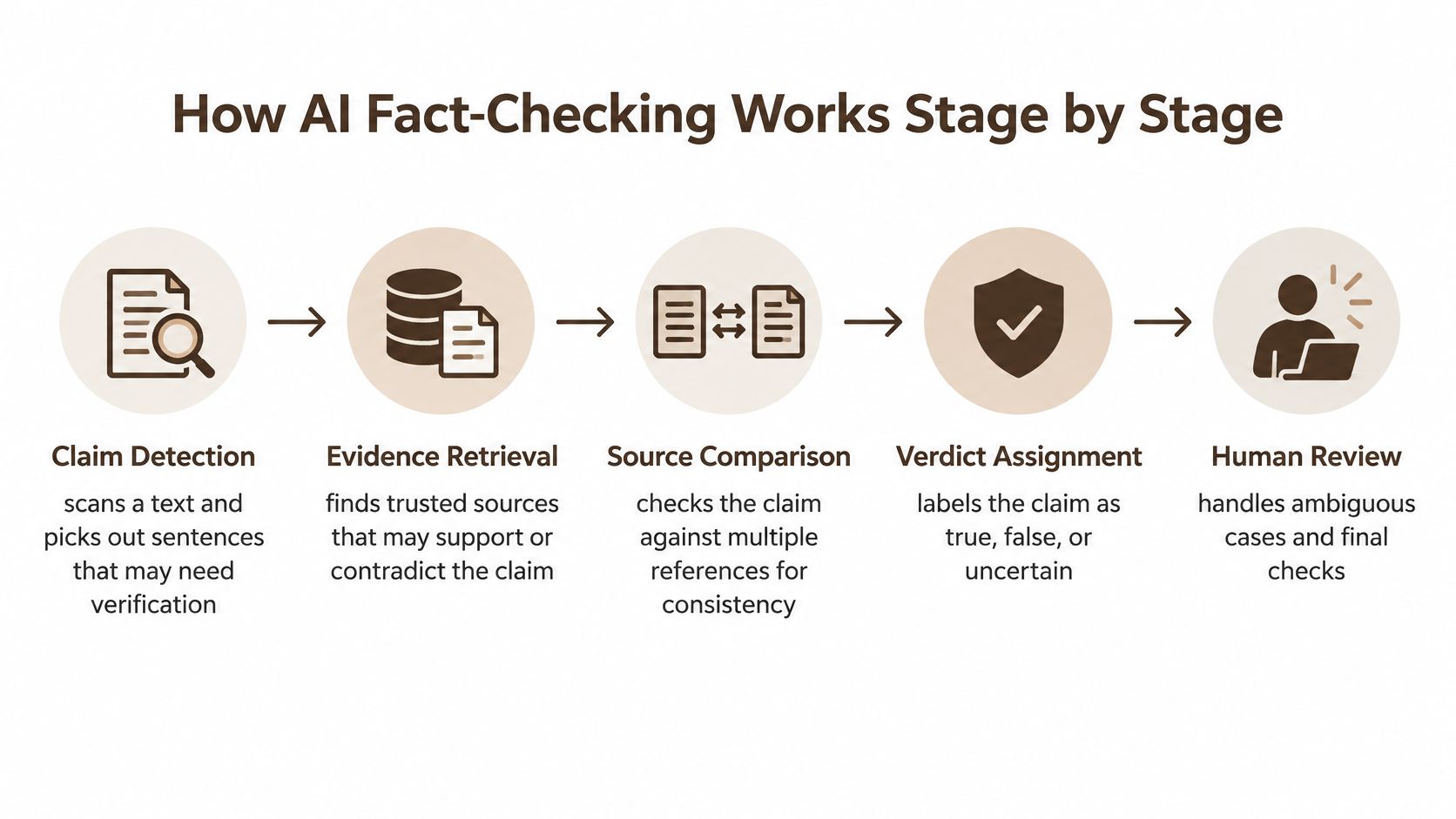
Most checkers, whether they sit inside a chatbot or a dedicated tool, follow one pipeline. A later miss almost always starts in an early stage, not in the wording of the final label.
Take one claim and keep it fixed. "City unemployment hit 6.2% in March 2024." Each stage does something different with that sentence.
From a sentence to a label
Claim detection scans the text and lifts sentences that assert something checkable, such as a number, a date, a quote, or a cause and effect link. It should skip opinions. "The mayor handled the jobs market badly" is not a checkable claim. If detection drops the unemployment sentence, nothing later can recover it.
Evidence retrieval searches the web, or an uploaded file set, for passages that might bear on the claim. Outdated pages and thin blogs often outrank the statistics release. The same risk shows up in tools built for instant document answers for researchers, when the file set is incomplete or the wrong page ranks first.
Source comparison marks each passage as supporting, contradicting, or silent. A story about unemployment in a different month is silent, not support. Verdict assignment turns those marks into true, false, mixed, or unresolved. Human review is the gate for ambiguous cases, and many consumer tools skip it.
What usually breaks
| Stage | Job | Typical break |
|---|---|---|
| Claim detection | Pick checkable sentences | An opinion is treated as a fact, or a buried number is skipped |
| Evidence retrieval | Find passages that bear on the claim | An old recap outranks the primary release |
| Source comparison | Mark support, contradiction, or silence | A partial match is treated as full support |
| Verdict assignment | Output true, false, mixed, or unresolved | Mixed evidence is forced into a binary label |
| Human review | Settle ambiguous cases | No person sees the case before the label ships |
A confident final label tells you little about which stage failed. Start every check by asking which passage the verdict rests on.
How Accurate AI Fact-Checkers Really Are
The methods in the table differ, so the percentages are not interchangeable. Together they show the same lopsided pattern. Catching a clear falsehood is easier than confirming that a claim is true.
| Study or source | What was tested | Reported accuracy |
|---|---|---|
| PNAS study on ChatGPT and news headlines | 20 true and 20 false headlines | 90% of false headlines correct, 15% of true headlines correct |
| Reuters Institute UK election factsheet | 300 chatbot answers to 100 questions | ChatGPT-4o 78% correct, Perplexity 83% correct |
| Study of 1,493 large-language-model outputs | Fact-checking across true and false claims | 60.4% overall, 100% on one false claim, 10.2% on one true claim |
| Automated fact-checking review and 2026 PLOS ONE study | Strongest systems trained on domain datasets | Roughly 65% to 75%, with 67% used as a realistic level |
A Reuters Institute factsheet scored 300 chatbot answers to 100 questions about the 2024 UK general election, in the two weeks before 4 July 2024. ChatGPT-4o was correct 78% of the time and Perplexity 83%. The rest were partially correct or false. The authors also noted that a different scoring method can move the result, so one percentage is not a fixed property of the model.
Why a single score misleads
A CEUR workshop paper looked at 1,493 model outputs and found overall accuracy of 60.4%. One false claim was handled at 100%, while one true claim fell to 10.2%. The systems did better on false claims than on true claims. An average hides that gap.
As summarized in a Boom report on the research, a recent review put the strongest automated fact-checkers, those trained on large domain datasets, at about 65% to 75%. A 2026 PLOS ONE study used 67% as a realistic level. Even then, people were more likely to accept misinformation that matched what they already believed. More accurate corrections did reduce endorsement of false claims.
A high aggregate score does not make a verdict on a true claim reliable.
Running several models, including through a mixture of agents, can expose disagreement. Disagreement is a reason to read the sources, not a substitute for them.
Where Retrieved Evidence Misleads the Model
More passages do not guarantee a better verdict. The RAGuard benchmark tested retrieval against misleading, supporting, and unrelated evidence drawn from Reddit. When misleading retrievals were introduced, every LLM-based retrieval system did worse than the same model with no retrieved text. Human annotators improved.
Placement matters too. Across HOVER, FEVEROUS, and ClimateFEVER, a context-length study found that accuracy generally fell as prompts grew longer. Relevant evidence near the start or the end was used better than evidence stuck in the middle. Gold evidence without filler helped on every dataset, with gains reaching 0.20 accuracy on FEVEROUS.
Three signs retrieval went wrong:
- Wrong page: The cited page never mentions the claim.
- Stale page: The page is older than the event it is used to describe.
- Echo page: The page is an aggregator repeating another site, not a primary record.
A fluent paragraph with a citation attached can still rest on weak retrieval. A sound system ranks source quality, detects contradictions, classifies evidence type, and abstains when passages disagree or leave the question open.
Which Sources Count as Reliable
Trust is a ranking, not a vibe. Use this order, strongest first, and stop only when two primary sources agree on both the value and its definition.
- Primary records. Official statistics releases, court filings, company filings, and the original study with its published methods.
- Peer-reviewed research and systematic reviews. Read the sample and the scope, not only the headline.
- Established newsrooms and wire services that name sources and publish corrections.
- Professional fact-checking organizations that show their method and the evidence behind each verdict.
Advocacy sites, anonymous blogs, and aggregators are leads. They are not proof.
Three questions for any page
Who measured it? The producer should say how the figure was defined and collected.
Do they correct mistakes in public? A publisher that never corrects is a weaker witness than one that does.
How old is the data relative to the event? A correct number for the wrong month is still a failed check.
Say an answer reports an unemployment rate and cites a news article. Open the national statistics release for that same month. Compare the figure and the definition, such as whether students or seasonal workers are included. Accept the claim only after that match. If the article and the release disagree, the release wins.
Stop when two primary sources agree on the value and on what the value means.
Sorting Out Conflicting and Changing Evidence
Sources can disagree without one of them being a fake. Only one row in this table means the evidence itself is unsettled. The other rows are mismatches you can often resolve.
| Cause of disagreement | What it looks like | How to check it |
|---|---|---|
| Source quality | A wire service and an anonymous blog report different figures | Review the publisher's track record and whether it cites primary data |
| Date | Figures differ because one source describes an earlier period | Compare publication and event dates before comparing numbers |
| Definition | Sources measure different things under the same name | Read the methodology and definitions in each source |
| Geography | The claim holds in one country or region but not another | Name the place and find data for that place |
| Evolving knowledge | Official or scientific guidance has been revised | Find the latest version and note its revision date |
| Genuine unresolved conflict | Credible sources disagree on the evidence itself | Mark the claim unresolved instead of forcing a verdict |
Why extra links can hurt
Retrieval systems often give too much weight to weaker material when sources conflict. A 2025 IJCAI paper found that adding media-background and credibility information improved Llama-3.1's F1 score by 10 percentage points and Mistral's accuracy by 5 points. Automatically predicted credibility stayed less reliable than judgments people curated by hand. More links do not automatically make an answer trustworthy.
Health, elections, climate, finance, and breaking news move fastest. Dates, source-quality notes, and an explicit unresolved outcome matter most there. Personal anecdotes and opinions are especially hard for web checkers, because there is often no public record that could confirm them.
Mark a claim unresolved when two credible primary sources still disagree after you have aligned date, definition, and place. Searching further, without a newer primary record, mostly adds noise. An unresolved label is more honest than a forced true or false.
How to Verify an AI Claim Step by Step
This protocol does not depend on any one product. It cuts search effort without pretending the model removed the risk. When retrieval is wrong, fluent prose makes the error harder to see.
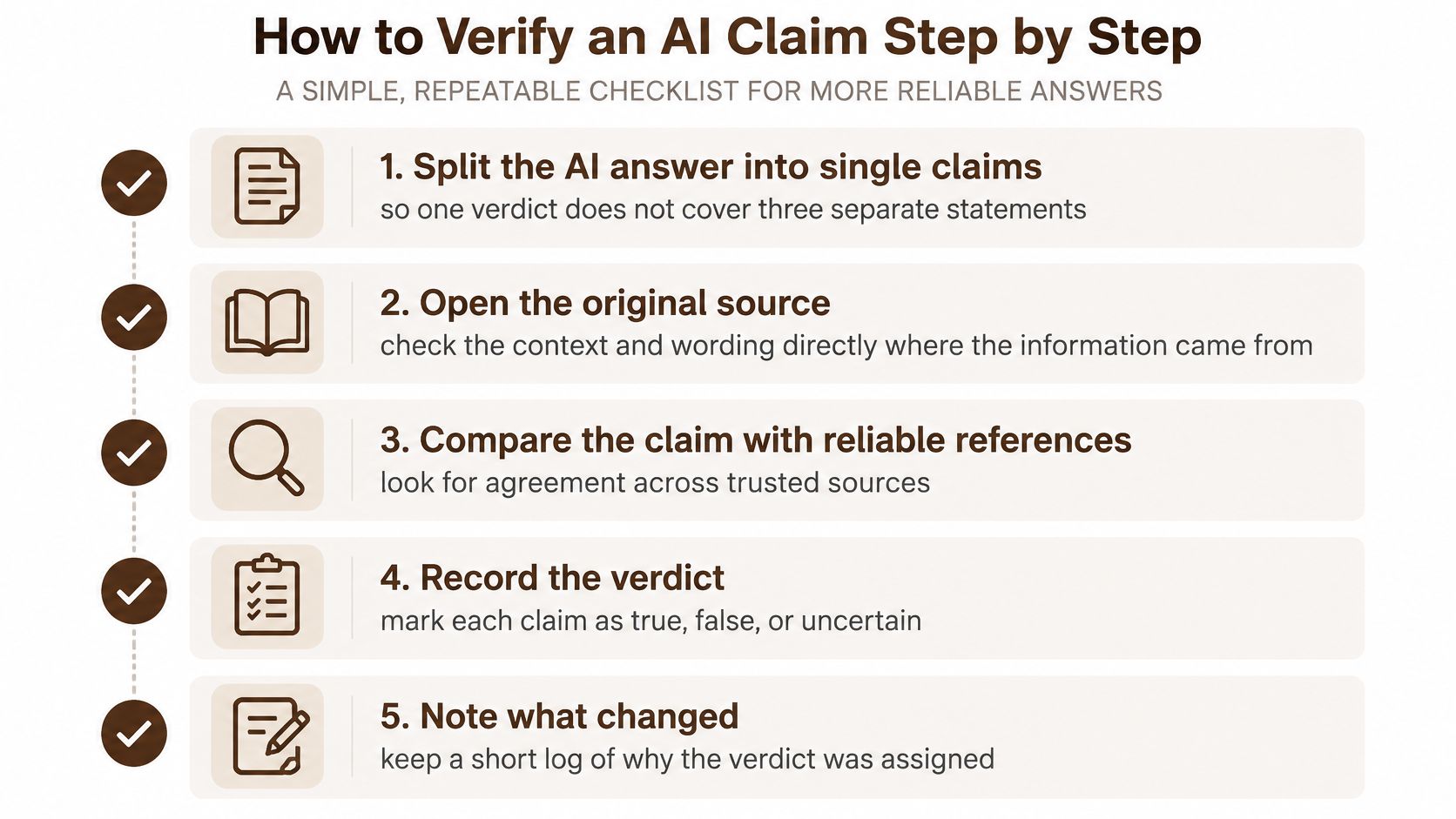
- Split the answer into single claims. One verdict should not cover three statements. The slip this prevents is accepting a whole paragraph because one sentence checked out.
- Open the cited source. Confirm it supports the exact number, place, and time period, not a nearby idea. The slip is treating a link as proof you never opened. For posts built on images, check news sources and context before you trust the caption.
- Check the publication date and the event date. Flag any gap. The slip is citing a 2022 page for a 2024 event.
- Seek two or three sources from different regions and political viewpoints. Note whether they agree. The slip is collecting three pages that all copy the first one.
- Remove the cited evidence, or reword the question, and run it again. If the answer changes, the first verdict was fragile. The slip is trusting one phrasing.
- Separate factual premises from value judgments. "Unemployment was 6.2%" can be checked. "That rate is unacceptable" cannot. The slip is scoring an opinion as if it were a measurement.
- Record a status for each claim. Verified, contradicted, or unresolved, plus how sure you are. The slip is remembering a vibe instead of a result.
The same discipline applies to tables. A guide to spreadsheet data analysis is a reminder that a summarized figure still has to match a cell, a definition, and a date. AI fact checking can shorten the search. It does not shrink the need to notice a wrong passage hiding inside a smooth explanation.
Checking Documents and Sensitive Files
Your own contract, invoice, or spreadsheet can be the source, and document-grounded answers still invent things. Research on document-based questions, reported in an arXiv study of model responses, found hallucinations in 30% of evaluated answers. Gemini and ChatGPT each hallucinated in about 40% of sampled answers. NotebookLM, the best system in that comparison, still hallucinated in 13%. Even the best rate means a file-grounded answer can contain unsupported text.
Match every flag to the file
Contracts. Open the page the model names and read the clause it flagged. A paraphrase can drop a condition, a date, or an exception.
Spreadsheets. Check each reported total against the original cell, including units and filters. A sum over the wrong column looks precise and is still wrong. Document analysis is only a starting pass over PDF, DOCX, and XLSX files.
Invoices. A "duplicate" claim needs the same invoice number, date, and amount. Two similar totals are not the same bill.
Retention before you upload
Personal data cannot be kept forever. The French data-protection authority CNIL says organizations must set a retention period for the purpose of the processing, tell people that period, and generally delete data when day-to-day development no longer needs it. Continued use for product improvement requires safeguards such as restricted access, partitioned storage, and stronger security.
Before you upload personal or confidential files, look for a stated retention period, a deletion route, and a commitment that chats and files are excluded from training. Treat each of those as a claim to verify, not as a slogan. If you want a local pass over sensitive text first, you can browse open source PII scanners and strip identifiers before anything leaves your machine.
A document review is finished only when every flagged item has been matched to its source page, cell, or invoice line.
Confirm Each Claim Before You Share It
You have three decisions, not one. Act, hold, or drop.
Act only on claims that pass both the source check and the date check. Hold anything still unresolved until a newer primary source settles it. Drop any claim whose cited source does not mention it at all.
Say an answer states that a city's population grew 12 percent, and the cited page covers a different year. Hold the claim. Search for the census release for the year the answer named. Do not share the 12 percent figure while the years disagree.
In our workspace, each finding in an answer points back to the document it came from, so you can open that file and verify the line. Agentic AI runs live web search and attaches the sources to its results so you can check them. A citation is a starting point, not proof. You still have to read the page. If you want a second look, run the same claim through more than one model. Disagreement is easier to spot when the answers sit next to each other.
Take one claim from your next AI answer and run the seven-step protocol on it before you share it.
BromeAI is a workspace for checking claims against live web sources and against the documents you upload, with findings tied back to those sources so you can verify them. If you are using AI fact checking for study, research, or file review, BromeAI lets you compare models in one place and read the attached sources before you act on an answer. Open a claim you already have and test it there before you pass it on.